
July 20, 2026
Coastal Air Effects on LA Exteriors
Written and reviewed by the Pressure Washing of Los Angeles team
Last reviewed:
| Key Takeaways Coastal salt, moisture, UV exposure, and wind can accelerate fading, corrosion, staining, and coating failure on exterior surfaces. Inspect siding, stucco, metal fixtures, concrete, windows, and trim for salt film, rust, peeling paint, algae, and recurring discoloration. Clean coastal properties based on actual exposure, wind conditions, and visible buildup rather than relying on a fixed annual schedule. Use surface-appropriate methods, including professional house washing or pressure washing, to remove salt and contaminants without damaging exterior materials. |
|---|
Homes and commercial buildings along the Southern California coast face environmental conditions that accelerate exterior wear beyond normal weathering. Salt carried inland by ocean air, combined with intense sunlight, coastal moisture, and wind, can gradually break down paint, corrode metal, stain hard surfaces, and shorten the lifespan of exterior materials.
Without regular maintenance, these effects often become more expensive to repair over time. This guide explains how coastal air affects exterior surfaces, the signs of damage to watch for, and practical ways to help protect your property.
Why Coastal Air Is Hard on Exterior Surfaces in Southern California
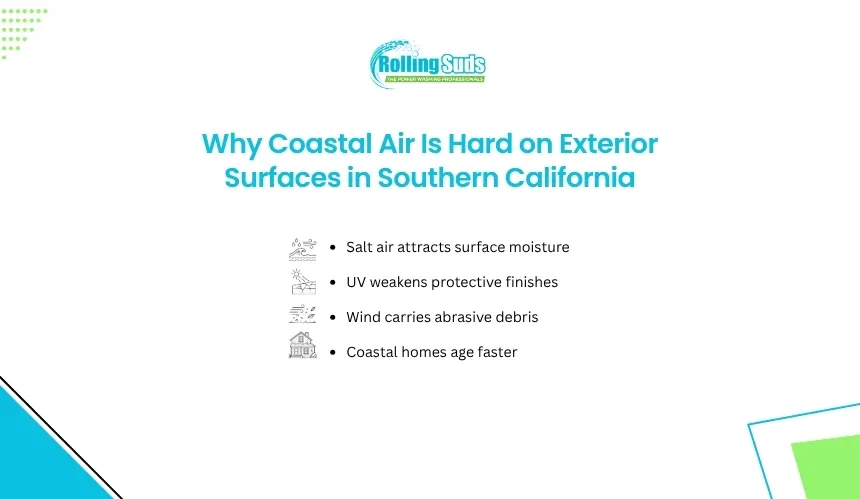
Southern California’s coastline creates a unique combination of environmental conditions that continuously expose exterior surfaces to salt, moisture, sunlight, and airborne particles. Unlike occasional weather events, these elements act year-round, gradually breaking down protective finishes and accelerating material deterioration.
Homes throughout Los Angeles, West Los Angeles, and nearby coastal communities often experience these effects more quickly than properties farther inland.
Salt-Laden Air and Airborne Moisture
The Pacific Ocean constantly releases microscopic salt particles into the atmosphere. Coastal winds carry these particles inland, where they settle on roofs, siding, windows, concrete, and other exterior surfaces. Although the salt layer may not be immediately visible, it attracts moisture from the air, keeping surfaces damp for longer periods and creating conditions that accelerate deterioration.
As salt accumulates, it can weaken paint adhesion, increase the likelihood of corrosion on exposed metals, and leave behind mineral deposits that become harder to remove over time. Regular pressure washing helps remove accumulated salt before it bonds tightly to exterior materials, reducing long-term surface degradation rather than simply improving appearance.
UV Exposure, Wind, and Temperature Fluctuations
Salt exposure is only one part of the equation. Southern California’s strong ultraviolet radiation gradually degrades paint, sealants, and protective coatings, making surfaces more vulnerable to salt intrusion. Coastal winds carry fine sand, dust, and airborne debris that create microscopic abrasion, while daily temperature changes cause materials to expand and contract, increasing stress on exterior finishes.
When these environmental factors work together, protective coatings deteriorate faster, allowing moisture and contaminants to penetrate deeper into the underlying material.
Why Homes Closer to the Coast Age Differently
Properties located near the shoreline generally experience greater exposure because salt concentrations in the air are significantly higher closer to the ocean. Homes in areas such as Santa Monica, West Los Angeles, and Culver City often require more frequent exterior maintenance than comparable inland properties due to continuous salt deposition and marine moisture.
Even homes several miles from the coast are not immune. Wind patterns can transport salt particles well inland, making routine exterior cleaning an important part of preserving siding, roofing, concrete, and other exposed building materials across much of the greater Los Angeles area.
Which Exterior Surfaces Are Most Affected?
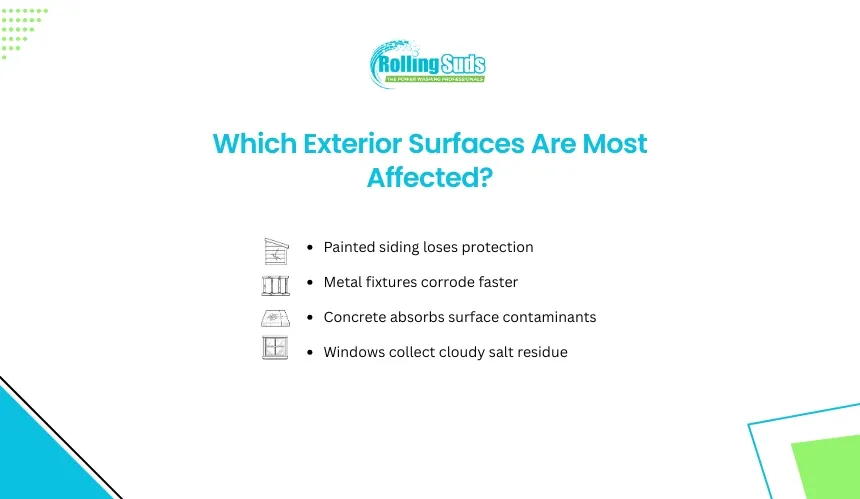
Not all exterior materials respond to coastal exposure in the same way. Surface composition, porosity, protective coatings, and exposure to sunlight and wind all influence how quickly deterioration occurs. Understanding which materials are most vulnerable helps homeowners prioritize maintenance before minor wear develops into costly repairs.
Painted Siding, Stucco, and Masonry
Painted siding serves as the first protective barrier against the elements, but continuous exposure to salt, ultraviolet light, and moisture gradually reduces its effectiveness. As coatings weaken, they become more susceptible to fading, chalking, peeling, and premature failure.
Stucco and masonry perform differently because they are porous materials. Salt and moisture can settle within tiny surface openings, contributing to discoloration, mineral deposits, and localized deterioration if contaminants remain on the surface for extended periods. Routine cleaning helps remove accumulated residue before it becomes embedded and more difficult to eliminate.
Metal Fixtures, Railings, and Hardware
Exterior metal components are among the most vulnerable materials in coastal environments. Railings, gates, light fixtures, fasteners, gutters, and exposed hardware can begin corroding when salt deposits repeatedly attract moisture to the surface.
Protective finishes eventually wear down, allowing oxidation to develop more rapidly than it would in inland environments. Once corrosion advances beneath coatings, repairs often require more than simple surface cleaning, making preventive maintenance a more cost-effective approach.
Concrete, Driveways, Patios, and Walkways
Concrete may appear durable, but it continuously absorbs environmental contaminants through its porous surface. Salt residue, airborne pollutants, and organic growth can gradually leave driveways, sidewalks, patios, and pool decks looking stained or weathered.
In neighborhoods across Beverly Hills, Hollywood, and West Hollywood, professional pressure washing is commonly used to remove salt buildup, surface contaminants, algae, and accumulated grime before they contribute to permanent discoloration or surface deterioration. Proper cleaning also helps restore traction by removing slippery organic growth from frequently used outdoor areas.
Windows, Glass, and Exterior Trim
Salt deposits often become most noticeable on windows and surrounding trim. Glass can develop a cloudy appearance as salt particles combine with dust and moisture, reducing clarity and leaving visible residue after drying.
Window frames, trim boards, and decorative exterior details are also exposed to continuous environmental stress. Without periodic cleaning, contaminants accumulate around joints, edges, and horizontal surfaces where moisture tends to linger, increasing long-term maintenance requirements for these highly visible architectural features.
What Are the Signs That Coastal Air Is Causing Damage?
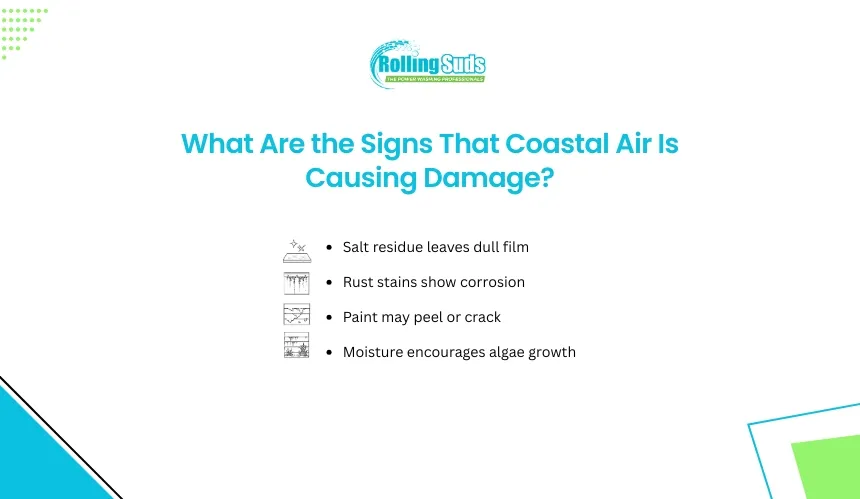
Coastal damage usually develops gradually rather than appearing after a single weather event. Identifying the early warning signs allows homeowners to address contamination before it progresses into material deterioration that requires repairs or refinishing.
Salt Residue, Discoloration, and Surface Staining
One of the earliest indicators is a thin layer of salt residue that traps dust, airborne pollutants, and moisture against exterior surfaces. This buildup often appears as a dull film, light streaking, or uneven discoloration on siding, windows, masonry, and painted finishes.
Areas that receive less rainfall or natural rinsing are especially prone to accumulation. Over time, these deposits become more difficult to remove because contaminants bond to the surface instead of remaining loose.
Corrosion, Rust, and Material Breakdown
Metal components exposed to coastal air often show visible signs before larger structural issues develop. Rust stains around fasteners, discoloration on railings, oxidation on fixtures, or corrosion near joints indicate that protective coatings are no longer preventing salt from reaching the underlying metal.
These issues should not be ignored, as corrosion can continue beneath the surface even after visible rust is removed. Regular inspections are particularly valuable for homes in Central Los Angeles, West Los Angeles, and other areas influenced by marine air.
Peeling Paint, Cracking Finishes, and Moisture-Related Issues
When protective coatings begin to fail, exterior finishes often lose their ability to resist environmental exposure. Paint may peel, blister, or crack, while sealants around trim, windows, and exterior joints become brittle or separate from the surface.
Persistent contamination can also encourage mildew or algae to develop in damp, shaded locations where moisture remains for longer periods. If salt deposits, organic growth, and dirt continue to accumulate, professional pressure washing in Los Angeles can remove these surface contaminants before repainting or other maintenance work, allowing protective coatings to perform as intended and reducing the likelihood of premature failure.
How Regular Exterior Cleaning Helps Protect Coastal Properties
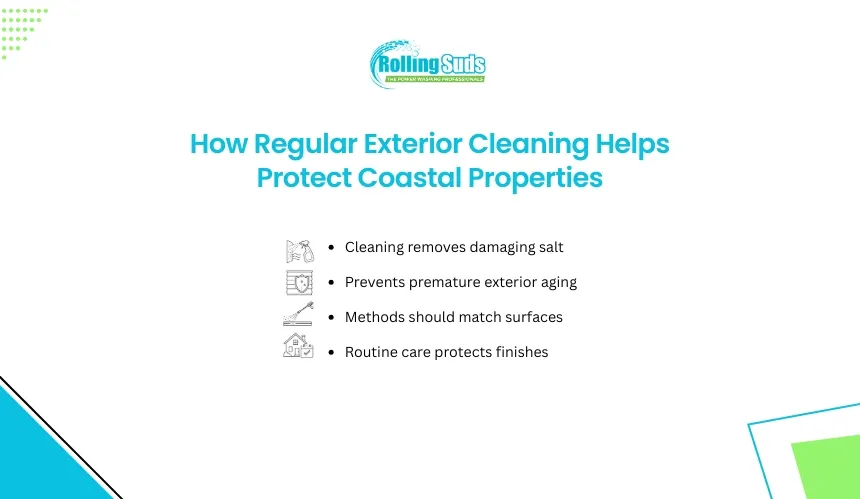
Removing visible dirt is only one benefit of exterior cleaning in a coastal environment. The primary objective is to eliminate salt deposits and other contaminants before they remain on surfaces long enough to accelerate deterioration. A preventive cleaning schedule is typically more effective and less expensive than restoring surfaces after damage has already occurred.
Why Salt Removal Matters More Than Appearance
Salt continues affecting exterior materials as long as it remains on the surface. It attracts moisture, holds contaminants against protective coatings, and increases the exposure time of materials to corrosive conditions. Even when a home appears clean, an invisible layer of salt may still be present.
Professional cleaning removes these deposits from siding, masonry, concrete, roofing, and other exposed materials, reducing the environmental stress that contributes to premature aging. The result is longer-lasting finishes rather than simply a cleaner appearance.
How Often Should Coastal Homes Be Cleaned?
There is no universal cleaning schedule because exposure varies by location, prevailing winds, surrounding vegetation, and the property’s distance from the coastline. Homes closer to the Pacific Ocean generally require more frequent maintenance than those farther inland, especially after periods of strong coastal winds.
Property owners in South Los Angeles, Downtown Los Angeles, and nearby communities can benefit from periodic inspections that determine whether salt residue, organic growth, or surface contaminants are beginning to accumulate instead of relying solely on a fixed calendar.
When buildup becomes noticeable, scheduling professional house washing in Los Angeles helps remove contaminants before they contribute to long-term exterior deterioration.
Professional Cleaning Methods for Different Surface Types
Different materials require different cleaning techniques to avoid unnecessary wear while achieving effective contaminant removal. Painted siding, stucco, concrete, roofing materials, and decorative masonry each respond best to cleaning methods suited to their condition and construction.
Professional pressure washing in Los Angeles, when performed with the appropriate equipment, water pressure, and cleaning approach for each surface, removes accumulated salt, dirt, algae, and pollutants without unnecessarily damaging exterior finishes. Matching the cleaning method to the material helps preserve both appearance and long-term durability in Southern California’s coastal environment.
Coastal salt, dirt, and environmental buildup do not have to shorten the life of your property’s exterior. Pressure Washing of Los Angeles powered by Rolling Suds of Beverly Hills provides professional residential and commercial pressure washing services throughout the Los Angeles area, helping restore and protect siding, concrete, roofs, and other exterior surfaces. Schedule your professional cleaning today and keep your property looking its best year-round.
Frequently asked questions
Can coastal salt damage a home even if it is several miles inland?
Marine aerosols can travel inland through prevailing winds, especially during dry or breezy conditions. Properties several miles from the Pacific may still collect salt on windows, siding, metal hardware, and rooftop components. Exposure usually decreases with distance, but elevation, wind direction, and surrounding buildings can influence how much residue reaches a property.
Does rain wash salt off exterior surfaces naturally?
Light rain may redistribute salt rather than remove it completely. When water evaporates, concentrated mineral residue can remain behind on glass, paint, stucco, and metal. A thorough rinse or professional house washing is more effective because it removes both visible deposits and the bonded film that ordinary rainfall may leave behind.
Can coastal air affect solar panels, outdoor lighting, or HVAC equipment?
Salt-laden moisture can accumulate on solar panel frames, outdoor light fixtures, fasteners, condenser coils, and electrical enclosures. Over time, this may reduce efficiency, promote oxidation, or weaken exposed connections. These components should be inspected and cleaned according to manufacturer guidance, since excessive pressure can damage seals, coatings, and delicate equipment.
Is soft washing safer than pressure washing for coastal homes?
Soft washing is often better suited to painted siding, stucco, roof materials, and other surfaces that can be damaged by high pressure. Pressure washing is generally more appropriate for durable concrete and masonry. The safest method depends on material condition, coating age, contamination level, and whether cracks or loose finishes are already present.
Should salt buildup be removed before repainting or sealing exterior surfaces?
Salt, chalking, mildew, and airborne pollutants must be removed before applying paint, sealant, or protective coatings. Coating over contaminated surfaces can reduce adhesion and cause bubbling, peeling, or premature failure. Proper surface preparation typically includes cleaning, drying, repairing defects, and confirming that no mineral residue remains.
Why do rust stains keep returning after they are cleaned?
Recurring rust usually indicates an active corrosion source rather than a surface-only stain. Common causes include exposed fasteners, damaged railings, corroded irrigation components, flashing, or metal fixtures above the stained area. Cleaning removes the discoloration, but the underlying metal must be repaired, sealed, coated, or replaced to stop recurrence.