Industrial Pressure Washing in Los Angeles
Built to handle
more than driveways.
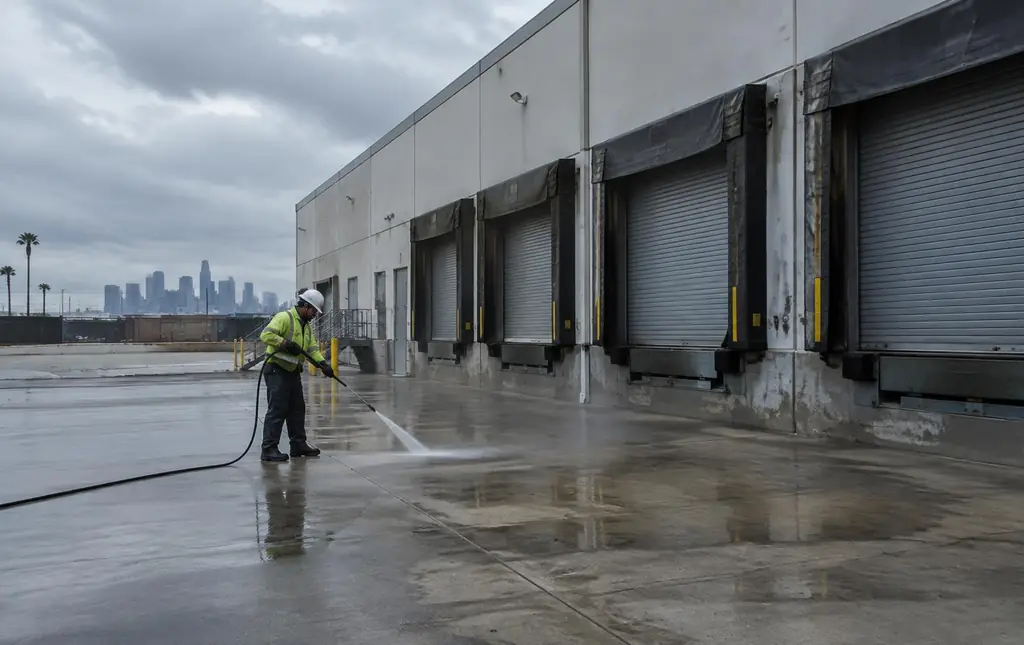
Industrial pressure washing and power washing for warehouses, manufacturing facilities, distribution centers, equipment yards and fleets. Oil, grease, dust and road grime — handled with methods selected for each surface, on a schedule or as a one-time job.
Site assessment
Surfaces, contaminants, access and shift schedules are reviewed first.
Matched methods
Degreasing, pressure and rinse are selected per surface.
Ongoing maintenance
Scheduled cleaning can be discussed for recurring needs.
Selecting methods for industrial surfaces
Industrial sites deal with contaminants that residential and most commercial properties don't: oil, grease, hydraulic fluid, chemical residue and heavy road grime from trucks and equipment moving across a yard all day. Hot-water power washing is used far more often here than in other categories, because grease and oil bond to concrete and steel in a way that cold water alone struggles to break down. Degreasing agents are applied first in heavily contaminated spots — loading docks, equipment pads, areas under parked trailers — before pressure is used to rinse the surface clean. Large open floor areas inside warehouses or across yards are typically cleaned with a surface cleaner attachment so the pressure washing is applied evenly instead of leaving overlap marks across a slab that size. Building exteriors made of metal panel or painted block still call for a gentler soft wash approach where coatings need to be preserved, even though the ground-level work nearby might be far more aggressive.
Common surfaces and problems on industrial sites
Loading docks see constant truck traffic, so diesel drips, brake dust and tire residue build up fast, often alongside spilled product depending on what moves through the dock. Warehouse and manufacturing floors accumulate oil, grease and dust from equipment and forklift traffic, and in some cases chemical residue specific to the operation. Equipment yards and fleet parking areas collect oil stains under vehicles and heavy machinery, plus general dirt and grime from outdoor storage. Building exteriors — metal siding, painted block, loading bay doors — pick up dust, exhaust film and in coastal-adjacent areas some salt residue on top of standard dirt and algae. Concrete floors and pads can also develop efflorescence or staining from standing water or chemical exposure over time, which is a different problem from surface dirt and needs to be addressed differently.
How quotes and scheduling are handled
Industrial quotes factor in the type and severity of contamination as much as square footage — a lightly dusty yard and an oil-saturated loading dock of the same size are very different jobs. Access and layout matter: whether trucks, trailers or equipment need to be moved or worked around, whether there's one entry point or several, and how much of the site is operational during the visit. Shift schedules are usually reviewed up front so cleaning can happen during a lull or after hours rather than disrupting active operations. Drainage and runoff requirements specific to the site or local regulations also factor into how a job is scoped. Many industrial clients set up scheduled service on a recurring basis — monthly, quarterly or seasonal — to keep grease and grime from building up to the point where it takes longer to remove each time, while others need a one-time cleanup ahead of an inspection, audit or change in tenancy.
Preparing a facility for a visit
Before a crew arrives, it helps to have a plan for moving trucks, trailers, pallets or equipment out of the areas being cleaned, or confirming which bays can be worked around if full relocation isn't possible. Any chemical spill locations or known problem areas should be pointed out ahead of time, since those may need a different approach than general grime. Confirm water and power access on site, and flag any area that can't get wet — electrical panels, certain stored materials, sensitive equipment. If the facility operates on shifts, deciding in advance which shift the work will happen around keeps the visit from interfering with production.
Picking the right service page for your facility
The surface and contaminant involved should point you to the right page. Oil and grease on a dock or floor is a degreasing and loading dock job. A fleet of trucks or heavy equipment with built-up grime is covered under equipment and fleet cleaning. Warehouse and manufacturing building exteriors are their own page when the issue is dust, exhaust film or general facade buildup rather than ground-level contamination. Floors and concrete pads with staining or efflorescence are addressed on the floors and concrete page specifically. If a site has several of these issues at once, a site assessment is the fastest way to confirm which methods apply where, since industrial properties rarely fit a single description.
Services
Industrial services
- 01Truck & Fleet WashingYour fleet is a moving billboard.
- 02Industrial Maintenance CleaningKeep the site running clean.
- 03Industrial Building Exterior CleaningOperational buildings. Clean exteriors.
- 04Factory & Manufacturing Facility CleaningClean where the work happens.
- 05Warehouse CleaningKeep the operation moving. Clean.
- 06Industrial Equipment CleaningDegrease it before you service it.
- 07Heavy Equipment Pressure WashingMud, grease and grime — off.
- 08Loading Dock CleaningWhere trucks meet the building.
- 09Industrial Floor & Concrete CleaningFooting you can trust.
- 10Oil & Grease RemovalDegreased, not just rinsed.
- 11Industrial Drone CleaningTall structures. Less access hassle.
Also available on request: industrial building exteriors, factory and manufacturing facilities, warehouse cleaning, industrial and heavy equipment, loading docks, industrial floors and concrete, oil and grease removal, industrial drone cleaning.
Facilities · fleets · operators
Request a site quote
Let's talk about the site.
Tell us what needs cleaning and where the property is located.