
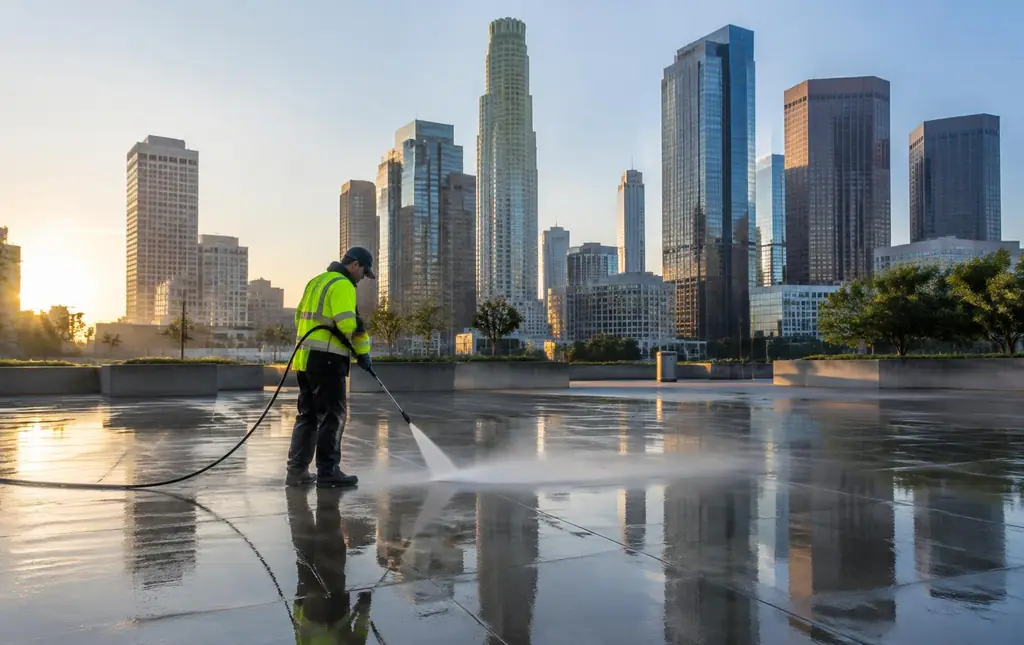
Commercial · Los Angeles, CA
Commercial Concrete Cleaning in Los Angeles
High-traffic concrete, reset.
Call (424) 324-3888Request a property quote
The service
Commercial Concrete Cleaning
What does commercial concrete cleaning address?
It deals with the patchy traffic paths, gum, spill spots and planter staining that build up on plazas, courtyards, entries, ramps and outdoor dining areas. Commercial surface cleaners give large areas one consistent tone, with gum and stains spot-treated and edges detailed.
Office plazas, campus courtyards and building entries carry thousands of steps a day. The result is grey, patchy concrete with gum, spills and traffic paths worn in. Commercial concrete cleaning brings these areas back to an even tone.
Large flat areas are cleaned with commercial surface cleaners for consistent results, edges are detailed, and gum and stains are spot-treated. Scheduling is set around building hours.
Problems addressed
- Traffic paths and patchy tone
- Gum and spill spots
- Planter and leaf staining
- Grime at doors and ramps
Surfaces
- Plazas and courtyards
- Building entries and ramps
- Public-facing sidewalks
- Outdoor dining and break areas
Property types
- Office buildings
- Corporate campuses
- Mixed-use developments
- Public plazas
What commercial concrete cleaning removes
Commercial concrete cleaning strips out ground-in foot traffic grime, tracked-in dirt that darkens the center of walkways, gum pressed flat by thousands of shoes, drink and food spills near seating, and the dull grey film that settles on plazas exposed to open air year-round. Leaf litter from planters and irrigation overspray near landscape beds also leave their own staining that gets lifted during the same pass.
What cleaning can't fix
Cleaning will not repair concrete that has spalled, cracked, or settled unevenly, and it will not restore color to slabs where the surface paste has worn away from years of abrasion. Old sealers that have gone cloudy or are peeling need to be addressed separately — washing over a failing sealer can make its condition more obvious rather than fixing it. Stains that have etched into the concrete chemically, such as some rust or fertilizer marks, may lighten but not fully disappear.
How we do it, and why this method
Large open spans like plazas and courtyards are run with a surface cleaner — a rotating, enclosed head that keeps water and detergent contained to a tight swath so the result is even from one end of the slab to the other, instead of the overlapping arcs a wand leaves behind. Edges along planters, columns and door thresholds are gone over separately by hand since the surface cleaner can't get flush into corners.
Gum and dark spill spots get a pre-treatment before the main pass because standard rinsing alone just pushes them around. Where a property has tenants or visitors during the day, sections are worked through in sequence so the whole area isn't blocked off at once.
What affects the cost
- Total square footage of plazas, courtyards and walkways drives most of the estimate.
- Gum density and the number of spot stains add treatment time beyond a standard rinse.
- Site access — whether hoses have to run long distances from a water source — affects labor.
- Scheduling outside business hours can change crew timing compared with daytime work.
- Planter beds, bollards and other obstacles along the concrete slow down edge work.
- Multiple separate concrete areas on one property add setup time versus one continuous slab.
More detail: pressure washing cost in Los Angeles.
When to schedule
Properties with heavy daytime foot traffic tend to notice buildup fastest and benefit from cleaning on a repeating basis rather than waiting until stains are obvious to visitors. Retail and office plazas often schedule around slower seasons for leasing or around planned landscaping work so everything looks consistent at once. There's no wrong season for this work outdoors; it comes down to how much traffic the concrete sees and how visible it is to the public.
What to expect on the day
The crew connects to an approved water source and walks the property first to flag planters, furniture, signage and any areas that need to stay dry. Movable furniture, mats and sandwich boards should be cleared off the concrete ahead of time if possible. Cleaning proceeds section by section with wet floor coverage managed as the crew moves, and most concrete is dry enough for normal foot traffic within a short window after the final rinse, though shaded areas take longer.
Questions
Commercial Concrete Cleaning FAQ
Can you work after hours?
Yes. Commercial concrete is often cleaned early, late or on weekends.
Can traffic paths be fully evened out?
Cleaning usually evens tone significantly. Wear that has physically changed the surface may still show.
Do you move furniture and planters out of the way?
Light furniture is often moved by the crew, but heavier fixtures and anything breakable should be cleared by property staff beforehand.
Will the concrete be slippery right after cleaning?
Wet concrete is slippery like any wet surface. Sections are rinsed and allowed to drain before foot traffic resumes, and wet areas are flagged while drying.
How often should a plaza or courtyard be cleaned?
That depends on traffic volume and how the space is used; busier public-facing areas are typically cleaned more often than low-traffic courtyards.
Can you remove oil stains dropped by delivery carts or vendors?
Fresh oil usually lifts well with degreasing. Oil that has sat for a long time may leave a lighter shadow after treatment.
Let's talk about your property.
Tell us what needs cleaning and where the property is located.