
June 22, 2026
How to Actually Remove Oil Stains from a Parking Garage Floor in LA
Written and reviewed by the Pressure Washing of Los Angeles team
Last reviewed:
| Key Takeaways: Fresh oil spills should be absorbed before adding water because rinsing too early can spread petroleum residue across more concrete pores. Concrete-safe degreasers work best when given proper dwell time, allowing them to break down motor oil, hydraulic fluid, and grease before scrubbing or pressure washing. Old or deep oil stains usually need stronger extraction methods such as poultice treatment or hot-water pressure washing, especially on driveways, sidewalks, and parking garage floors. Pressure washing is most effective after pre-treatment; using high pressure without emulsifying the oil first can spread contamination and leave embedded residue behind. Long-term prevention depends on fast spill cleanup, routine pressure washing, leak monitoring, and using concrete sealers where appropriate. |
|---|
Oil stains on parking garage floors are more than a cosmetic issue. Once petroleum-based fluids penetrate concrete, they create dark discoloration, reduce surface traction, and become increasingly difficult to remove with standard cleaning methods.
In high-traffic Los Angeles parking structures, repeated vehicle leaks, heat exposure, and tire movement can drive oil deeper into the slab.
Effective removal depends on the age of the stain, the condition of the concrete, and the cleaning method used. This guide explains the practical process for removing fresh and embedded oil stains from parking garage floors while avoiding common cleaning mistakes.
Why Are Oil Stains Hard to Remove from Parking Garage Floors?
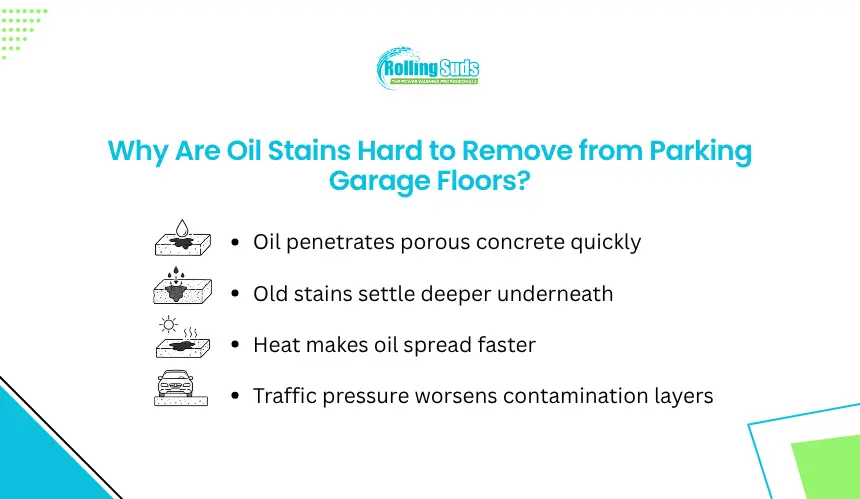
Oil stains are difficult to remove because the problem extends below the visible surface. Most parking garage floors are constructed from porous concrete, allowing petroleum-based fluids to migrate into microscopic voids where surface cleaning cannot reach.
How Does Oil Penetrate Concrete Pores?
Concrete contains interconnected capillaries that absorb liquids through capillary action. When motor oil, transmission fluid, or hydraulic fluid reaches the surface, it begins soaking into these pores almost immediately. The longer the oil remains untreated, the deeper the contamination spreads beneath the surface layer.
Unlike dirt or debris, oil does not simply sit on top of the concrete. It bonds to pore walls, creating discoloration that remains visible even after basic washing.
Why Do Old Stains Need Stronger Treatment Than Fresh Spills?
Fresh spills are largely concentrated near the surface, making absorption and degreasing more effective. Older stains have already migrated deeper into the concrete matrix, leaving residual hydrocarbons trapped below the visible stain.
As oil oxidizes and accumulates dirt, tire residue, and environmental contaminants, the stain becomes denser and more resistant to conventional cleaning products. Surface scrubbing alone often removes only the upper layer while leaving embedded contamination behind.
How Do LA Traffic, Heat, and Vehicle Leaks Make Stains Worse?
Parking facilities throughout Los Angeles experience conditions that accelerate stain penetration. High pavement temperatures in areas such as Downtown LA, Koreatown, and the San Fernando Valley reduce oil viscosity, allowing fluids to move deeper into concrete pores.
Frequent vehicle turnover creates additional pressure as tires repeatedly compress contaminated areas. In commercial garages, apartment complexes, and mixed-use properties, recurring leaks from multiple vehicles can create layered contamination that becomes progressively harder to extract from the floor system.
Step-by-Step Process to Remove Fresh Oil Stains
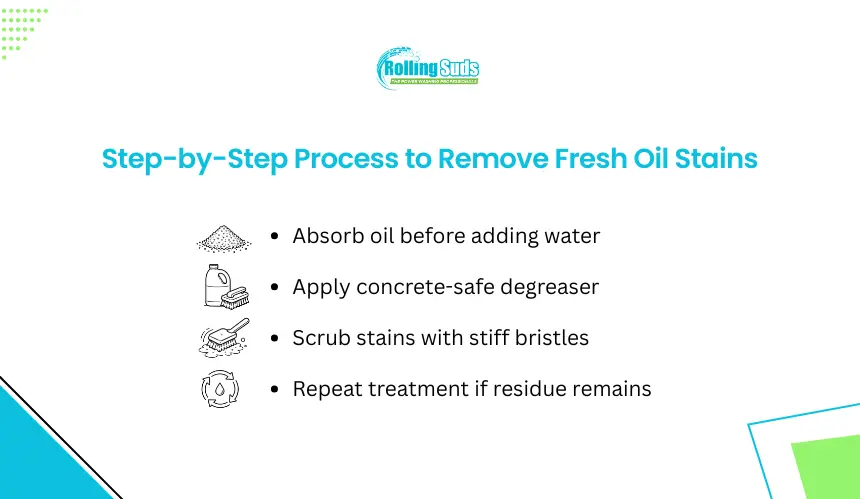
Fresh oil spills have the highest likelihood of complete removal because contamination is still concentrated near the surface. The objective is to stop penetration quickly, break down petroleum residue, and remove remaining contaminants before they become embedded in the concrete.
1. Absorb the Oil Before Adding Water
The first step is removing as much free-standing oil as possible. Applying absorbent materials such as oil absorbent granules, clay-based absorbents, or commercial spill media pulls liquid from the surface before it migrates deeper into the slab.
Water should not be used at this stage. Rinsing a fresh spill can spread contamination across a larger area and carry oil into additional concrete pores.
2. Apply a Concrete-Safe Degreaser
After absorption, apply a degreaser specifically formulated for petroleum contamination on concrete surfaces. The product should be allowed to dwell according to the manufacturer’s specifications so it can emulsify and break down oil molecules.
The goal is not simply to clean the surface but to separate the hydrocarbon residue from the concrete, making extraction possible during the next cleaning stage.
3. Scrub, Rinse, and Repeat if Residue Remains
Use a stiff-bristle brush or mechanical floor scrubber to agitate the treated area. Scrubbing increases contact between the degreaser and contaminated pores, improving removal efficiency.
Once agitation is complete, rinse the area thoroughly and inspect the surface after it dries. Light staining may disappear after one treatment, while heavier fresh spills may require a second application. Repeating the process immediately is more effective than allowing the remaining residue to sit and penetrate further into the concrete.
How to Treat Old or Deep Oil Stains
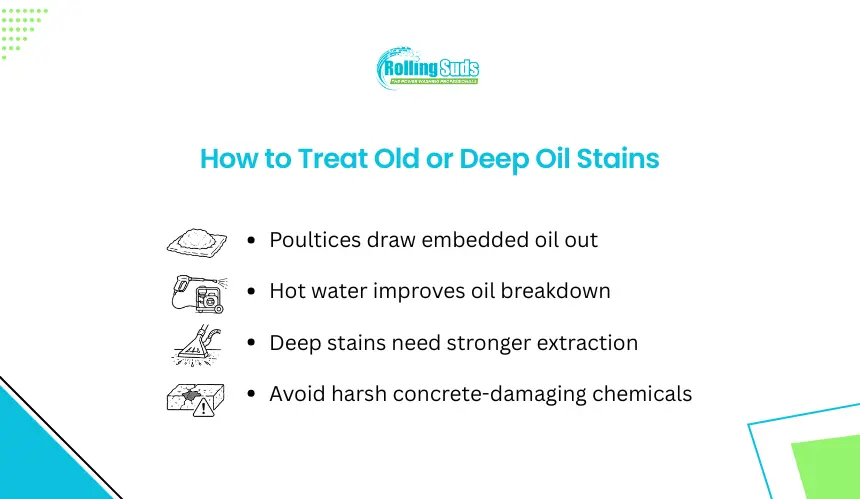
Once oil has penetrated beyond the surface layer, standard scrubbing and rinsing become significantly less effective. Deep stains require extraction methods that pull contamination out of the concrete rather than simply cleaning the visible surface. The same challenge is frequently encountered on heavily stained driveways and sidewalks exposed to long-term vehicle leaks.
Use a Poultice for Embedded Oil
A poultice combines an absorbent material with a cleaning agent to draw oil out of concrete pores over an extended period. After application, the mixture is left in place until it dries, allowing contaminants to migrate from the concrete into the absorbent compound.
This method is particularly effective when dark staining remains after conventional degreasing. For older concrete surfaces, multiple applications may be required to achieve noticeable improvement.
When Does Hot-Water Pressure Washing Work Best?
Hot-water pressure washing is often used when oil contamination covers larger sections of concrete. Heat reduces the viscosity of petroleum residue, allowing degreasers to penetrate more effectively and making extraction easier during washing.
For driveways and sidewalks cleaning in Los Angeles, hot-water systems generally outperform cold-water washing because they break down oily deposits rather than simply pushing them across the surface. The process is especially useful where repeated vehicle leaks have created widespread staining.
Why Avoid Harsh Chemicals on Concrete Surfaces?
Strong solvents, acids, and unapproved chemical cleaners can damage concrete, strip protective sealers, and create uneven surface discoloration. In some cases, aggressive products remove part of the concrete finish while leaving the underlying oil stain partially visible.
A controlled cleaning approach produces better results than excessive chemical strength. Professional driveway and sidewalk cleaning services typically match the cleaning agent to the stain type, concrete condition, and contamination depth to maximize stain removal while protecting the surface itself.
Mistakes That Make Parking Garage Oil Stains Worse
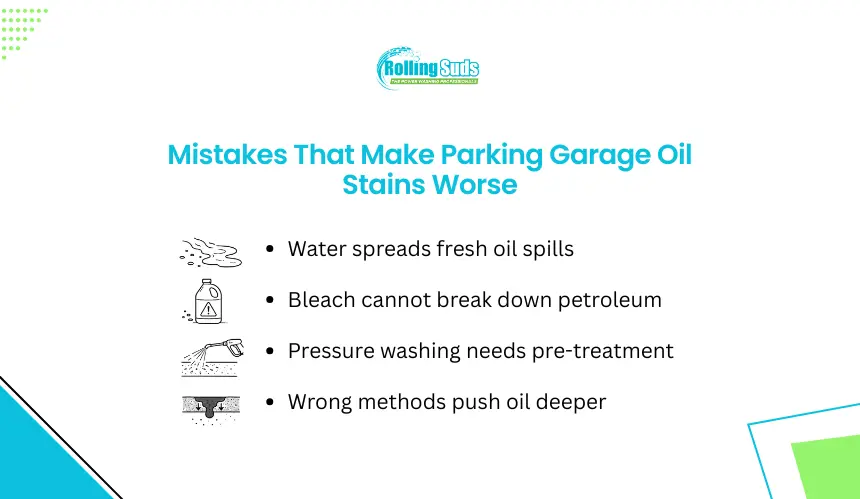
Many oil stain removal failures occur because the wrong cleaning method is used during the early stages. Certain practices can drive contamination deeper into the concrete, spread the affected area, or leave surfaces unsafe for vehicle and pedestrian traffic.
What Happens When Oil Is Rinsed Before It Is Absorbed?
A common mistake is spraying water directly onto a fresh oil spill. Instead of removing the contamination, water often spreads oil across adjacent concrete and pushes residue into additional pores.
In parking structures, this can transform a localized stain into a larger cleaning problem that requires more aggressive treatment later.
Why Is Bleach the Wrong Cleaner for Oil Stains?
Bleach is designed to address biological growth, staining, and discoloration, not petroleum contamination. It may lighten surface appearance temporarily, but it does not break down motor oil, hydraulic fluid, or grease deposits.
As a result, the underlying contamination remains trapped in the concrete while the stain gradually reappears after exposure to traffic and weather.
Why Is Pressure Washing Often Used for Oil Stain Removal?
Pressure washing is commonly used after degreasers have broken down oil contamination within the concrete surface. The combination of pressure, water volume, and, in some cases, heated water helps flush loosened petroleum residue from the concrete more effectively than manual scrubbing alone.
However, pressure washing works best when paired with proper pre-treatment. Using pressure without first emulsifying the oil can spread contamination and reduce cleaning effectiveness. For heavily stained concrete surfaces, many property owners rely on residential pressure washing in Los Angeles to remove oil buildup, restore appearance, and reduce slippery residue on driveways, sidewalks, and parking areas.
When Does a Parking Garage Floor Need Professional Cleaning?
Some oil stains reach a point where consumer-grade cleaners and standard pressure washers cannot deliver meaningful results. The decision to bring in professional cleaning services is usually based on contamination size, stain depth, and operational requirements rather than appearance alone.
Large Stains Across Multiple Parking Spaces
When oil contamination extends across several parking stalls or driving lanes, cleaning becomes a surface restoration project rather than a spot-treatment task. Larger affected areas require consistent degreaser application, commercial-grade extraction equipment, and controlled wastewater management.
Without uniform treatment, cleaned sections can appear noticeably different from the surrounding concrete, creating an inconsistent surface appearance.
Recurring Leaks in High-Traffic Areas
Some parking garages experience continuous contamination from tenant vehicles, fleet vehicles, or frequently used parking zones. Even after a successful cleaning, new oil deposits can accumulate quickly in the same locations.
Professional cleaning is often more effective in these situations because technicians can remove layered contamination that has built up over multiple leak cycles rather than addressing only the most recent stain.
Compliance, Safety, and Appearance Concerns for LA Properties
Commercial buildings, multifamily developments, retail centers, and mixed-use properties throughout Los Angeles often have operational standards that extend beyond stain removal. Oil-contaminated concrete can create slip hazards, reduce property appearance, and affect tenant or visitor perception.
For garages in areas such as Downtown LA, Santa Monica, Century City, and Hollywood, professional cleaning is frequently used to maintain cleaner traffic surfaces, improve safety conditions, and address deeply embedded petroleum staining that cannot be removed through routine maintenance methods.
Persistent oil stains often require more than household degreasers and rental equipment. Pressure Washing of Los Angeles, powered by Rolling Suds of Beverly Hills, provides professional exterior cleaning services for residential and commercial properties throughout the Los Angeles area.
The team specializes in pressure washing, soft washing, driveway and sidewalk cleaning, parking garage cleaning, building exteriors, and concrete surface restoration using commercial-grade equipment and professional cleaning solutions.
How to Prevent Oil Stains from Coming Back
Removing existing stains is only part of the solution. Long-term results depend on reducing future contamination and preventing oil from penetrating the concrete again.
- Clean new spills immediately: Fresh oil is significantly easier to remove than embedded contamination. Prompt cleanup limits penetration and reduces the likelihood of permanent staining.
- Inspect recurring leak locations: Parking spaces with chronic vehicle leaks often become the source of repeated staining. Identifying and addressing these areas early prevents contamination from spreading across the garage floor.
- Apply concrete sealers where appropriate: A properly selected concrete sealer can reduce oil absorption by creating a protective barrier on the surface. This makes future cleaning faster and more effective.
- Schedule routine pressure washing: Periodic cleaning removes oil residue, tire marks, road grime, and petroleum buildup before they become deeply embedded. Regular maintenance is particularly valuable in high-traffic parking facilities throughout Los Angeles.
- Monitor high-use traffic lanes: Entrance lanes, turning areas, and frequently occupied parking spaces typically accumulate contaminants faster than other sections of the garage and may require more frequent cleaning attention.
Sources
Frequently asked questions
Can pressure washing remove oil stains without a degreaser?
Pressure washing alone is not reliable for oil stain removal because petroleum residue clings inside concrete pores. Without a degreaser, high pressure may only move surface residue outward and leave embedded contamination behind. Pre-treatment breaks down hydrocarbons first, allowing pressure washing to extract loosened oil more effectively.
Why do oil stains sometimes reappear after cleaning?
Oil stains can reappear when contamination remains below the cleaned surface layer. As the concrete dries, trapped petroleum residue may migrate upward and darken the surface again. This is common with older stains, repeated vehicle leaks, or concrete that was cleaned too quickly without enough dwell time.
How long should a parking garage floor dry after oil stain cleaning?
Drying time depends on airflow, concrete porosity, humidity, and cleaning volume. In many LA parking structures, the surface may look dry within a few hours, but deeper pores can retain moisture longer. Vehicle traffic should return only after the surface is dry, residue-free, and no longer slippery.
Can oil stain cleaning damage sealed or coated concrete?
Improper cleaning can weaken sealers, dull coatings, or create uneven surface patches. Coated garage floors need compatible degreasers, controlled pressure, and careful rinsing. Before treating large areas, the cleaner should identify whether the floor has a topical coating, penetrating sealer, epoxy layer, or bare concrete surface.
What should happen to oily runoff during garage floor cleaning?
Oily runoff should be controlled so it does not spread across clean concrete, enter landscaped areas, or collect in pedestrian paths. Professional cleaning often involves containment, recovery, or directed drainage management depending on the site layout. This matters most in multi-level garages, sloped ramps, and buildings with interior drain systems.
How often should LA parking garages schedule oil stain maintenance?
High-traffic garages in Los Angeles usually need more frequent cleaning because heat, vehicle turnover, tire residue, and recurring leaks accelerate buildup. Monthly spot checks and periodic deep cleaning work well for multifamily, retail, and commercial garages. Low-traffic properties may only need scheduled service after visible staining develops.