June 22, 2026
Drone Cleaning vs Rope Access: Which One Is Best for Your LA Building?
Written and reviewed by the Pressure Washing of Los Angeles team
Last reviewed:
| Key Takeaways: Drone cleaning is best for Los Angeles buildings with large, open glass, metal, or cladding surfaces that need routine washing with minimal setup. Rope access is better for complex facades, recessed windows, ledges, signage, balconies, and heavy stains that require direct hand cleaning. Drone cleaning can reduce disruption around entrances, sidewalks, loading areas, and active tenant spaces because it usually needs a smaller ground footprint. Rope access takes more time but provides greater precision where facade details, bonded dirt, or uneven surfaces limit drone cleaning performance. Building owners should compare height, facade design, access limits, contamination level, and maintenance goals before choosing drone cleaning, rope access, or a hybrid approach. |
|---|
Drone cleaning and rope access cleaning are both used to maintain commercial building exteriors, but they operate very differently and are not equally suited to every property.
For building owners and facility managers in Los Angeles, the right choice often depends on factors such as building height, facade design, access limitations, safety requirements, and operational disruption.
This article compares drone cleaning and rope access cleaning to help determine which approach best fits your Los Angeles building’s cleaning needs.
How Drone Cleaning and Rope Access Cleaning Differ
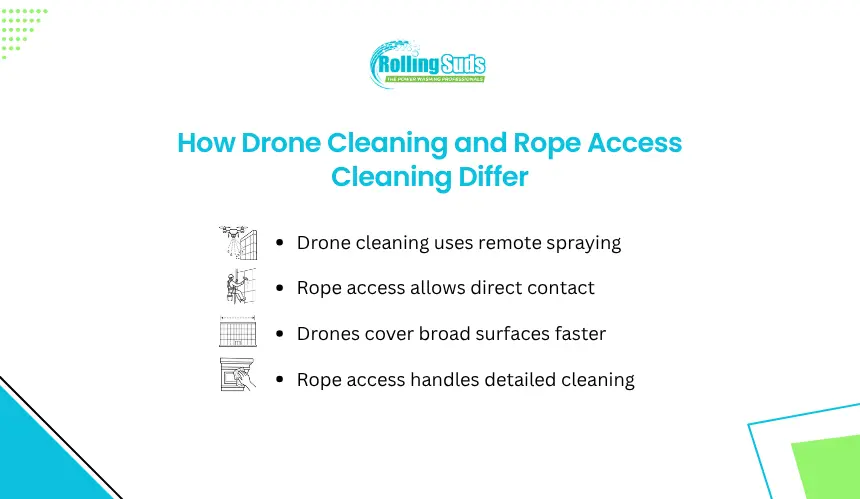
Drone cleaning and rope access cleaning are both designed to maintain building exteriors, but they achieve access, cleaning delivery, and project execution through entirely different methods. Understanding these operational differences is the foundation for determining which solution aligns with a property’s specific requirements.
How Does Drone Cleaning Work on Building Exteriors?
Drone cleaning uses remotely operated aerial systems equipped with spray nozzles that apply purified water or approved cleaning solutions directly onto exterior surfaces. The drone remains airborne while an operator controls positioning, coverage patterns, and cleaning intensity from the ground.
Because the equipment reaches surfaces without requiring workers to physically access the facade, drone cleaning minimizes the need for scaffolding, suspended platforms, or rope systems. This approach is commonly used for glass, metal panels, cladding systems, and other exterior surfaces where contaminants can be removed through low-pressure washing techniques.
The effectiveness of drone cleaning depends heavily on surface type, contamination level, weather conditions, and the ability of the cleaning solution to break down dirt without manual agitation.
How Does Rope Access Cleaning Reach Difficult Areas?
Rope access cleaning relies on trained technicians who descend or position themselves along a building facade using specialized rope systems anchored at the roof level. Workers perform cleaning directly by hand, allowing them to inspect, clean, and address specific areas with a high degree of precision.
Unlike drone systems, rope access technicians can physically interact with the surface. They can remove stubborn buildup, clean around architectural details, reach recessed sections, and adjust techniques based on varying facade conditions.
This direct-contact approach is particularly valuable on buildings with complex geometries, decorative features, deep setbacks, or areas where contaminants require more than a spray-and-rinse process.
What Are the Key Operational Differences Between the Two Methods?
The primary difference lies in how access is achieved and how cleaning is performed.
Drone cleaning prioritizes remote operation, reduced setup requirements, and rapid surface coverage. It is generally most effective when the cleaning objective focuses on removing environmental dirt, dust, and light surface contamination across large exterior areas.
Rope access cleaning prioritizes direct human access and detailed surface treatment. It provides greater flexibility when cleaning requirements involve precision work, heavy staining, intricate architectural elements, or surfaces that benefit from manual cleaning techniques.
For Los Angeles buildings, the choice often comes down to whether the project requires broad exterior coverage with minimal physical access or detailed cleaning in areas where human intervention remains necessary.
Which Method Performs Better for Different Los Angeles Building Types?
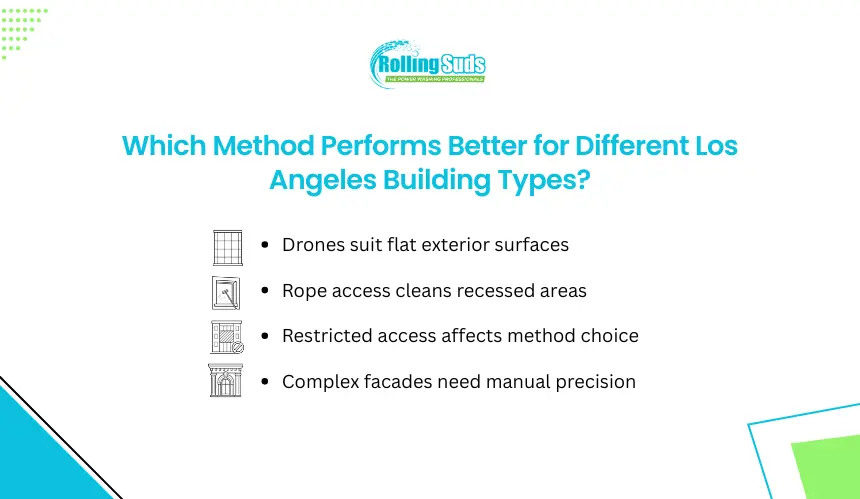
Building design, facade layout, and site access determine whether drone cleaning or rope access can deliver better results. In Los Angeles, this decision often depends on how easily equipment can operate around balconies, setbacks, neighboring structures, traffic zones, and rooftop anchor points.
Mid-Rise and High-Rise Commercial Buildings
Drone cleaning can perform well on mid-rise and high-rise buildings with broad, uninterrupted exterior surfaces, especially glass curtain walls, flat cladding, and vertical panels. It reduces the need for suspended staging when the cleaning task is mainly surface rinsing or controlled solution application.
Many commercial buildings throughout Los Angeles feature large glass and metal facades that benefit from efficient exterior coverage. In these situations, drone cleaning in Los Angeles can reduce access complexity while maintaining consistent cleaning across expansive surface areas.
Rope access is usually stronger when high-rise buildings have irregular facade sections, recessed windows, ledges, signage, or areas that require hand detailing. Technicians can adjust pressure, tools, and contact time directly at the surface, which matters when dust, mineral deposits, bird waste, or pollution film has bonded to exterior materials.
Buildings With Restricted Ground Access
Drone cleaning is useful when ground-level setup space is limited by sidewalks, parking lots, landscaping, courtyards, or active commercial entrances. Since most operations occur from a controlled launch area, it can reduce interference with tenant access and pedestrian movement.
Rope access may be more practical when airspace movement is limited by nearby power lines, narrow alleys, overhangs, adjacent towers, or dense urban corridors. In these conditions, a technician working from certified roof anchors can maintain closer control over positioning without relying on drone flight clearance near obstacles.
Complex Facades, Architectural Features, and Tight Spaces
Rope access performs better on buildings with balconies, fins, louvers, deep window frames, textured stone, facade projections, and non-uniform elevations. These surfaces often create shadow zones where spray coverage is inconsistent or where debris collects in edges and recesses.
Drone cleaning is better suited to simpler exterior planes where the nozzle can maintain a consistent angle and distance from the surface. When the facade includes tight corners, underside areas, or layered architectural details, drone cleaning may leave untreated zones unless the building geometry supports safe and precise flight paths.
Safety, Disruption, and Cleaning Efficiency Comparison
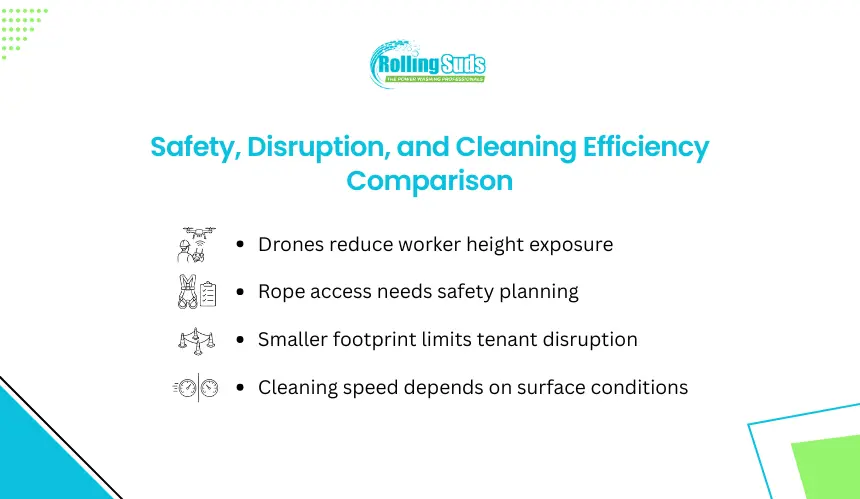
For many property managers, the decision extends beyond cleaning performance. Safety requirements, tenant impact, and project efficiency often influence which method is practical for a specific building and operating environment.
Worker and Public Safety Considerations
Drone cleaning reduces the amount of time workers spend suspended on building exteriors because cleaning is performed remotely from the ground. This can lower exposure to certain fall-related risks associated with working at height.
Rope access remains a highly controlled method when performed by certified technicians, but it involves personnel operating directly on the facade. Safety planning typically includes anchor inspections, rescue procedures, weather monitoring, and controlled work zones around the building perimeter.
Impact on Building Occupants and Daily Operations
Operational disruption varies depending on building location and surrounding activity. In busy Los Angeles districts such as Downtown LA and Century City, access restrictions, pedestrian traffic, and tenant activity can complicate exterior maintenance projects.
Drone cleaning generally requires a smaller ground footprint, which may reduce interference around entrances, walkways, and loading areas. Rope access projects may require larger exclusion zones and additional coordination when technicians are working above occupied spaces.
Cleaning Speed and Project Efficiency
Drone cleaning can cover large facade sections quickly when surfaces are accessible and contamination levels are relatively light. Reduced setup requirements may also shorten project timelines for routine building washing in Los Angeles.
Rope access is often slower because technicians clean surfaces directly and reposition throughout the project. However, that additional time can provide greater precision on buildings where facade complexity, heavy soiling, or detailed cleaning requirements limit the effectiveness of broad surface coverage methods.
When Should You Choose Drone Cleaning vs Rope Access?
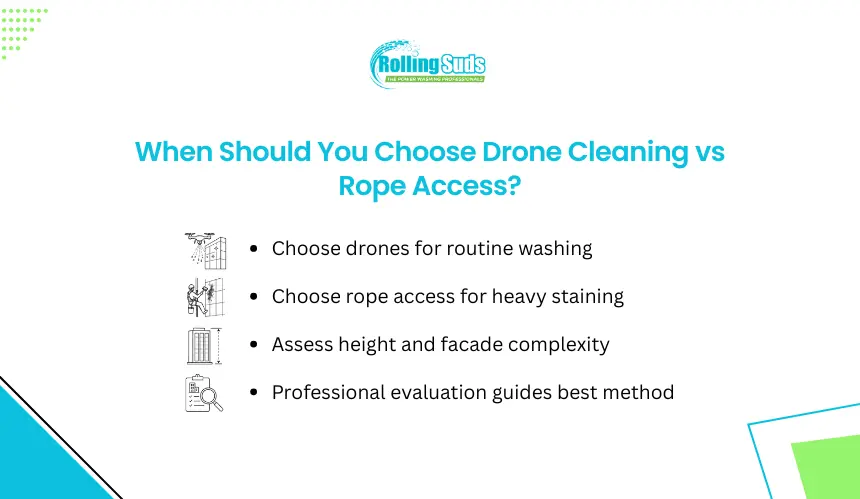
The right choice depends on the building’s design, cleaning objectives, and access conditions. Neither method is universally better, as each is suited to different operational requirements.
When Is Drone Cleaning the Better Choice?
Drone cleaning is often the better option when a building has large, accessible exterior surfaces that require routine washing rather than detailed manual cleaning. It can also be advantageous when minimizing setup time and reducing disruption to occupants or pedestrians is a priority.
When Is Rope Access the Better Choice?
Rope access is generally the stronger choice for buildings with complex facades, recessed areas, architectural features, or heavy contamination that requires direct surface treatment. It provides greater precision when cleaning quality depends on hands-on access.
What Should Building Owners Consider Before Deciding?
Before selecting a cleaning method, evaluate the building’s height, facade complexity, access restrictions, contamination level, and maintenance goals. A professional site assessment can determine whether drone cleaning, rope access, or a combination of both will deliver the most effective result.
Sources
Frequently asked questions
How do I know if my building facade is suitable for drone cleaning?
A facade is more suitable for drone cleaning when it has open vertical surfaces, limited projections, and enough space for safe flight positioning. Glass curtain walls, metal panels, and flat exterior cladding are common fits. Buildings with balconies, deep recesses, or dense overhead obstacles usually require closer evaluation before approval.
Can drone cleaning remove heavy stains from commercial building exteriors?
Drone cleaning is effective for dust, light pollution residue, loose dirt, and routine exterior buildup. Heavy staining, mineral deposits, oxidized surfaces, adhesive residue, or deeply bonded contaminants often require manual agitation, dwell-time control, or surface-specific tools. In those cases, rope access may provide better cleaning accuracy.
Is rope access safer than scaffolding for high-rise exterior cleaning?
Rope access can reduce the need for large scaffolding systems, but safety depends on certified technicians, anchor testing, rescue planning, and site controls. It is commonly used where scaffolding is impractical or disruptive. The safest option depends on facade layout, work duration, access points, and surrounding pedestrian activity.
Do Los Angeles buildings need special planning before exterior cleaning?
Exterior cleaning in Los Angeles often requires planning around sidewalks, traffic flow, tenant entrances, neighboring properties, and weather conditions. Dense areas such as Downtown LA, Hollywood, and Century City may need tighter access coordination. Water use, runoff control, and work-zone safety should also be reviewed before scheduling.
Can drone cleaning and rope access be used on the same building?
Some buildings benefit from a hybrid approach. Drone cleaning can cover broad facade sections quickly, while rope access technicians handle recessed windows, stubborn stains, ledges, signage, or architectural details. This approach can improve efficiency without sacrificing precision, where manual surface contact is still needed.